The most common mistake on this coast is treating it as a distance to be covered.
From Salerno to the tip of the Sorrentine peninsula is barely fifty kilometres. A reasonably quick boat could run the whole thing between breakfast and lunch, tick off every town on the postcard, and be back before dark. Guests occasionally arrive expecting to do something close to that, and it is an entirely logical instinct — you have a week, and there is a coastline in front of you.
It is also the surest way to see very little.
What separates a good week here from an ordinary one is almost never the route. It is the timing. The same anchorage is a different place at eight in the morning and at one in the afternoon, and the difference is not subtle.
The coast runs on a daily rhythm
In summer, the wind on this coast is largely thermal. The land heats through the morning, a sea breeze fills in around midday, builds through the afternoon and dies away at dusk. It is reliable enough that you can plan around it, and it explains a pattern that first-time guests often find counter-intuitive.
The water is at its calmest and emptiest before ten. The towns are at their best after seven. The middle of the day, when most people are moving, is when the sea is busiest and the light is at its least flattering.
So an experienced captain will cruise early, anchor and swim through the middle of the day, and go ashore in the evening. Guests who let the crew set that rhythm consistently report a better week than guests who arrive with a fixed schedule. This is worth knowing before you plan anything.
Day one — Salerno to Amalfi
Board in the afternoon at Salerno. Provisioning is straightforward there and the marina is twenty minutes from the motorway, which matters more than it sounds when a party is arriving from three different airports.
The first leg west is deliberately short — an hour or so under the cliffs, with the ceramics town of Vietri falling astern and the coast steepening as you go. There is a reason to keep the first afternoon gentle. A crew learns a great deal in the first few hours about how a party likes to be looked after, and it is easier to learn that at anchor than underway.
Anchor off Amalfi and take the tender in. La Caravella, in the old town, has been cooking since 1959 and remains the clearest statement of what Campanian food actually is.
Day two — Ravello above, Furore below
Give the morning to Ravello. The gardens of Villa Rufolo hang three hundred and fifty metres above the water, and in summer the terrace becomes the stage for the town's music festival.
Take a car, arranged in advance. The road up is a series of hairpins shared with buses, and it is not a drive to improvise on the morning.
Back aboard by early afternoon, run west past the Fiordo di Furore — a cleft in the cliff so narrow it looks painted on. There is no anchorage inside, which is precisely why it stays as it is.
Day three — Positano, early
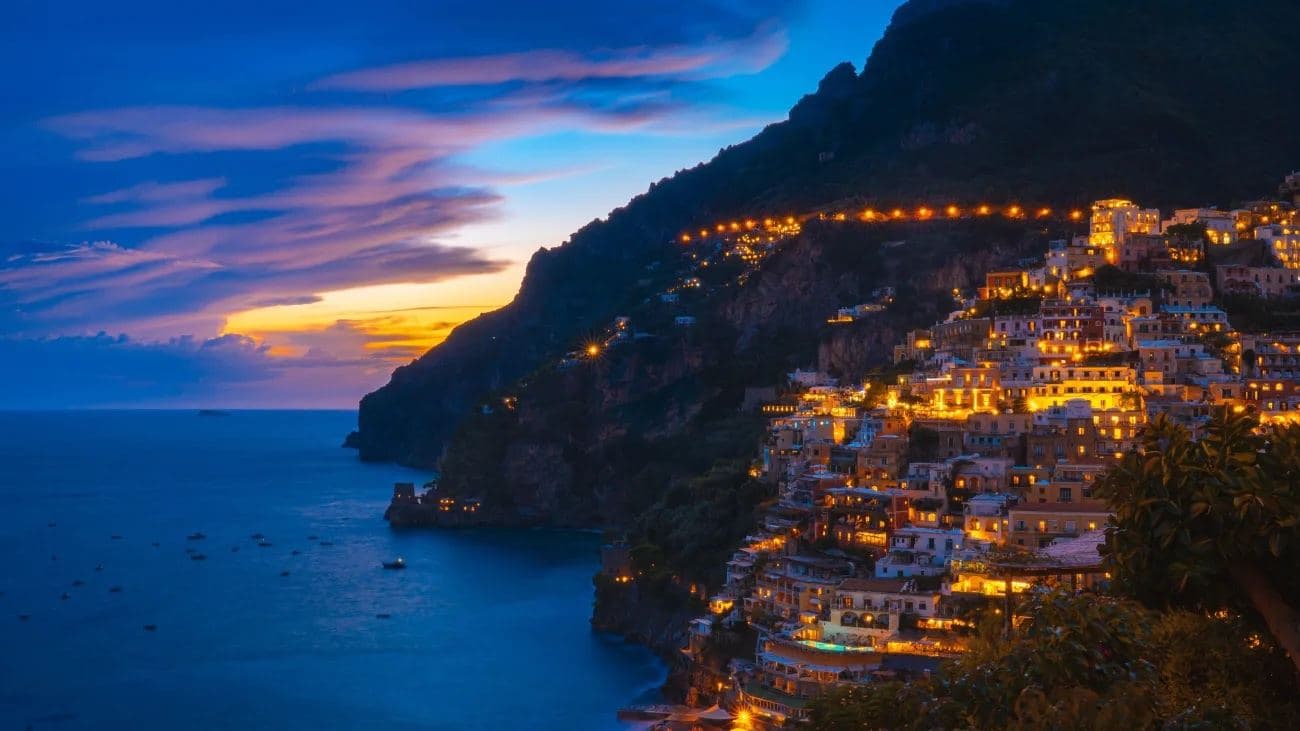
Positano photographs beautifully from the water and is at its best at eight in the morning, before the day boats arrive and the bay fills with tenders. An hour's difference here changes the entire character of the place.
Anchor off Laurito for lunch at Da Adolfo, which can only be reached by sea and grills mozzarella on a lemon leaf. It is not a secret and has not been for decades. It remains a pleasure.
Walkers can be dropped at Bomerano for the Path of the Gods: seven kilometres of clifftop trail down into Nocelle, roughly three hours, with the yacht repositioning to collect them at the other end. Splitting the party for half a day is easier than most guests assume, and it is one of the quiet advantages of travelling this way.
Day four — Nerano and the peninsula
Round into the Bay of Ieranto and Marina del Cantone, where the coast finally quietens. Lo Scoglio serves the best raw seafood on this shoreline — sea urchin, red prawns, anchovies — and booking is a requirement rather than a suggestion. A few hundred metres away, Quattro Passi holds two Michelin stars and a spaghetti alla Nerano that people genuinely plan trips around.
Between the two, Cala di Mitigliano: a cove reachable only from the sea, where the water is clear enough to watch the anchor set on the bottom.
Day five — Capri, in the right order
Cross early. The Blue Grotto is entered lying flat in a small rowing boat through an opening barely a metre high, and by mid-morning the wait can run past an hour, in the sun, in a queue of boats. First light is the only civilised time to go, and the cave closes without notice in any swell from the north-west.
Circle the Faraglioni afterwards and pass through the arch in the middle stack. Then anchor off Marina Piccola for the afternoon and go ashore in the evening, once the last hydrofoil has taken the day visitors back to Naples and the island returns to the people staying on it.
Day six — Ischia
A longer leg north-west to the green island: thermal springs, an Aragonese castle on its own islet, and a fraction of Capri's traffic. Sant'Angelo on the south coast is the anchorage to aim for, and the thermal gardens above it make a genuinely restorative afternoon after five days of swimming and sun.
Day seven — back to Salerno
Run back down the peninsula with the whole week in view at once. Most parties ask for a final swim off Conca dei Marini before the marina. Disembarkation is usually mid-morning, and onward transfers are arranged long before anyone starts thinking about them.
Practical notes
- Late May to early July, and September, give you the same water as August with a fraction of the traffic. August is glorious and crowded in equal measure; the good anchorages fill by eleven.
- Restaurant tables on this coast are booked out weeks ahead in high season. Dates shared early are dates we can hold tables for.
- Motor yachts suit day charters and short hops along the coast; catamarans and sailing yachts are the choice for a full week aboard.
- Build one flexible day into the week. Weather here rarely cancels anything, but it frequently reorders it.
A week is not measured in miles
The parties who enjoy this coast most tend to be the ones who let go of the itinerary somewhere around day three. They stop asking what is next and start asking how long they can stay where they are.
That is the point of arriving by sea. Not that you can see more of the coast, but that you can be somewhere ordinary people cannot be, at an hour when nobody else is there.
If you are thinking about a week here, tell us your dates and who is coming, and we will talk it through properly before anything is booked.