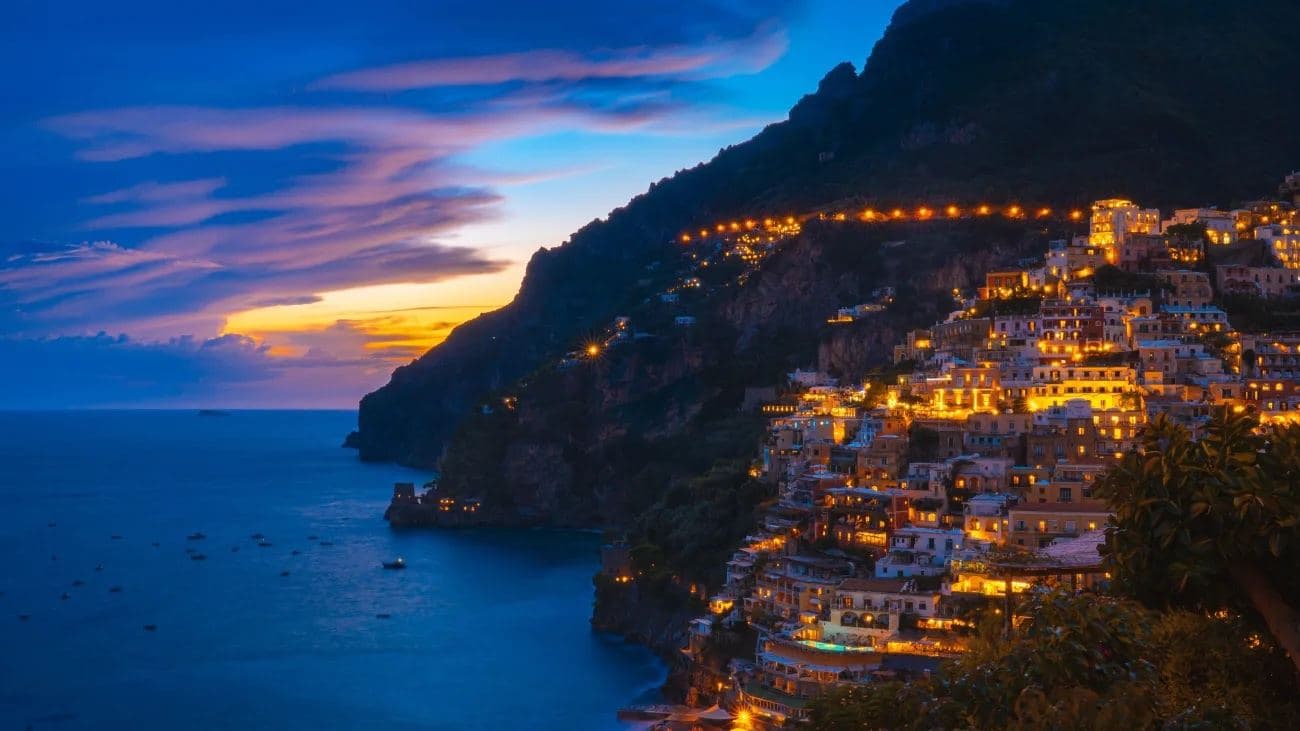
People often describe the Aeolians as the Amalfi Coast with fewer people. It is an understandable comparison and a thoroughly misleading one.
Amalfi is a single cliff face read from one end to the other. You are never more than a few minutes from shelter, and the passages between anchorages are measured in minutes. The Aeolians are seven separate islands scattered across open water north of Sicily, and the water between them is genuinely open.
That difference is not a detail. It determines what kind of holiday this is, what kind of boat it needs, and how much time it honestly requires.
You actually sail here
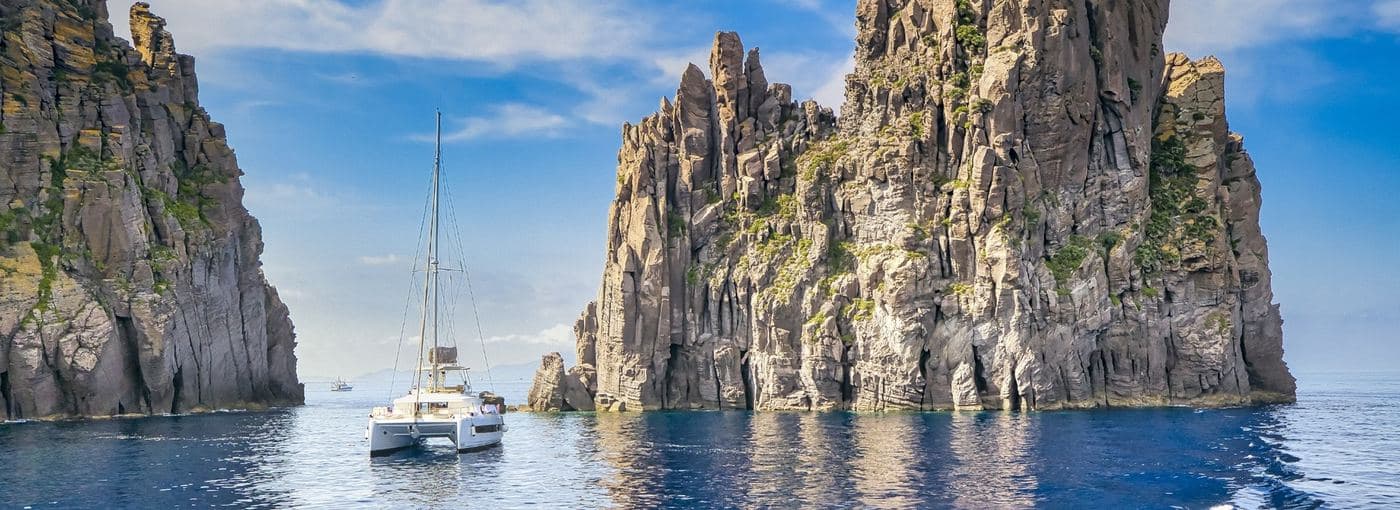
Legs between the islands run two to four hours. There is real wind, real fetch and a horizon in every direction, and on a good afternoon the sailing is the point rather than the transport.
This suits sailing yachts and catamarans. It suits parties who are happy to be underway for half a morning. It suits people who want the sea itself to be part of the week, not merely the space between restaurants.
It suits a day boat considerably less. Most charters start from Portorosa or Capo d'Orlando on the Sicilian north coast, both within a morning's sail of Vulcano and Lipari.
Vulcano
The nearest island, and a loud introduction. The Gran Cratere is about an hour on foot and gives you the whole archipelago in one view.
The naturally warm sulphur pools at the port are restorative and — there is no polite way to put this — memorable at some distance downwind. Leave the swimwear you care about aboard.
Lipari
The largest and most inhabited island, and the practical hub of any week here: provisioning, pharmacies, a working town.
The archaeological museum in the citadel holds one of the most complete prehistoric collections in the Mediterranean. It exists because of obsidian — volcanic glass that made these islands a trading power four thousand years before anyone thought to charter a yacht here. Standing in it recalibrates what you are actually sailing through.
Sail the west coast for the pumice and obsidian flows at Canneto, where white quarries run straight into water that turns an improbable pale turquoise.
Salina
The green one. Two extinct cones, vineyards, caper terraces and the Malvasia that most guests end up taking home.
Santa Marina makes an easy overnight. At Lingua, a brackish lagoon cut off from the sea draws migratory birds and looks back across the water to Lipari and Vulcano. Eat on the seafront at Porto Bello — caper pesto, macaroni with cuttlefish ink — and take wine aboard before you leave.
Panarea
The smallest, smartest and busiest of the seven in August. Anchor off Cala Junco, among the finest bays in the archipelago, and walk up to the Bronze Age village on the headland above it. Cusiritati is the island's benchmark for cooking.
North-east lies Basiluzzo, an uninhabited islet with submerged Roman moorings still visible from the surface. It is the snorkelling stop of the week and almost nobody stops there.
Stromboli
The reason most people come.
Stromboli has been in near-continuous mild eruption for something close to two thousand years, throwing incandescent material from its summit every twenty minutes or so. In daylight it looks like an ordinary steep island. After dark it does not.
The classic approach is to lie off the Sciara del Fuoco, the black scar down the north-west flank where material runs into the sea, and watch from the deck at dusk. Guided ascents towards the crater are possible with a licensed volcano guide, take roughly three hours return, and depend on the alert level on the day. The summit is not something to improvise.
Whether the night at Stromboli happens at all depends on the sea state and the volcano's mood. Your captain will make that call on the day, and it is the one evening of the week worth staying flexible for.
Filicudi and Alicudi
The far west, and the quiet. Filicudi has the Grotta del Bue Marino and La Canna, a lava needle rising seventy metres straight out of open water.
Alicudi, further still, has no cars, barely any roads and around a hundred residents. If someone in the party wants to know what these islands were like fifty years ago, Alicudi is the answer, and it is only reachable this way.
Planning notes
- Allow a full week. Six days is possible, but the days you lose are Filicudi and Alicudi, and that is where much of the character lives.
- The crossings are open water. This is an archipelago for sailing yachts and catamarans rather than day boats.
- June and September give you the same sea as August with a fraction of the traffic.
- Build flexibility around Stromboli rather than around the rest of the week. Everything else can be reordered easily.
A landscape still being made
What stays with people afterwards is rarely a single anchorage. It is the sense of being somewhere unfinished — where the rock is still arriving, the ground is warm in places, and the island you are looking at is measurably different from the one your grandparents would have seen.
The Amalfi Coast is a place to be looked after. The Aeolians are a place to be paying attention.
If a week of proper sailing appeals more than a week of short hops, tell us your dates and we will talk through which of the two coastlines actually fits your party.